
Check out our latest products
![[Upgraded] USB Computer /Laptop Speaker with Stereo Sound & Enhanced Bass, Portable Mini Sound Bar for Windows PCs, Desktop Computer and Laptops](https://m.media-amazon.com/images/I/61NAayKmVIL._AC_SL1500_.jpg)


| Google Pixel 10 Series – Starting At $799, Find It On Amazon The Pixel 10 ($799), Pixel 10 Pro ($999), and Pixel 10 Pro XL ($1199) are Google’s best flagship phones yet. They update last year’s Pixel 9 series with a more efficient processor platform, brighter displays, meaningful camera tweaks, larger batteries, faster charging, and Qi2 magnetic accessory support, though US models lack a SIM tray.
|
|||

|


|
||
It’s that time of year again. After weeks of leaks and rumors, Google has finally unveiled its new flagship lineup for 2025, which consists of a trio of standard phones (Pixel 10, 10 Pro, and 10 Pro XL), a book-style folding phone (Pixel 10 Pro Fold), a smartwatch (Pixel Watch 4), and mid-range earbuds (Pixel Buds 2a). A lot is riding on these new Pixel handsets, which are also the physical manifestation for Google’s ambitious AI strategy.
These Pixel phones also continue to pave the way for Google’s SoC independence, with the Tensor G5 dropping Samsung’s Exynos IP, adopting a semi-custom Arm core architecture and built on TSMC’s 3nm manufacturing process. At the same time, with these phones, Google continues to set an example for other Android handset manufacturers by adding Qi2 magnetic accessory support (for the better) while simultaneously removing the SIM tray from US models (for worse).
So let’s dive into Google’s three flagship bar phones – the Pixel 10 ($799), Pixel 10 Pro ($999), and Pixel 10 Pro XL ($1199) – and find out what’s new. What are these handsets like? Are the updates over last year’s Pixel 9 series meaningful? Should you pick one up? Let’s find out in our full review.
Pixel 10 Series Hardware, Design, And Build Quality
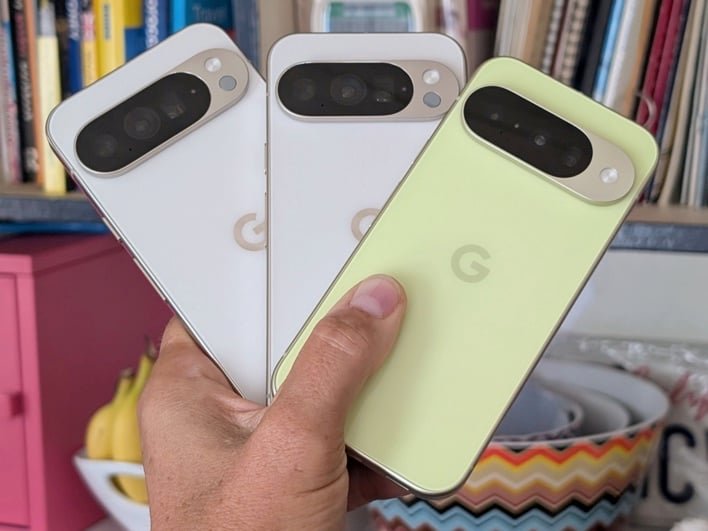
We hope you like the Pixel 9 series’ industrial design, because aside from some new colors, the Pixel 10 lineup looks pretty much identical. Dimensions are virtually the same (the Pixel 10 is marginally thicker than the Pixel 9 at 8.6mm vs. 8.5mm) and the new phones are slightly heavier. But there’s a good reason for this: these are the first Android flagships with Qi2 magnetic accessory support – ie. magnets under the rear glass.
Last year’s HMD Skyline was technically the first Android handset to support Qi2 with magnets, better known as MagSafe in Apple-land, and introduced with the iPhone 12 series. Google calls it Pixelsnap and we think it’s a great name. Qi2 with magnets enables wireless charging (up to 25W on the Pixel 10 Pro XL) and gives the Pixel 10 lineup access to Apple’s vast MagSafe ecosystem of accessories. In other words, this is a huge win.
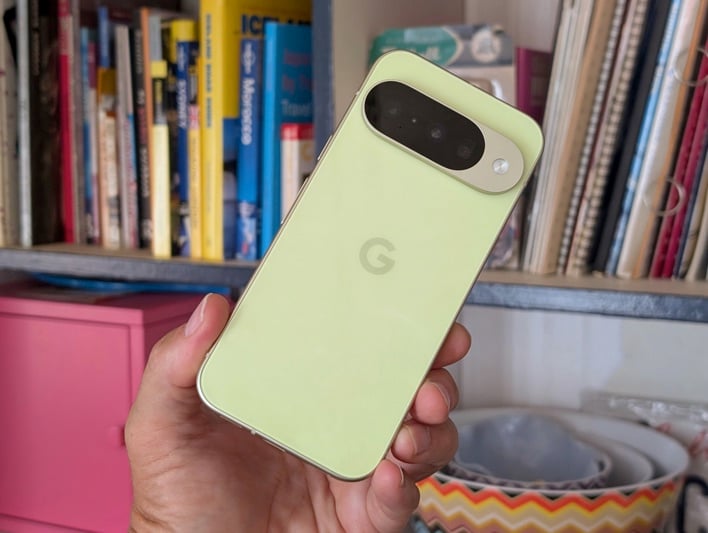
But it also begs the question: what took so long? It’s about time major Android phone manufacturers adopted Qi2 with magnets, and we hope Google starts a trend, and compels Samsung to follow suit. Like the Pixel 9 series, these three Pixel 10 handsets are Gorilla Glass Victus 2 and aluminum sandwiches, and feature the latest, pill-shaped iteration of Google’s iconic camera visor (the horizontal bar housing the rear shooters).
Like before, the Pixel 10 features a satin aluminum frame and shiny glass back, while the Pixel 10 Pro and 10 Pro XL have a polished aluminum frame and matte rear glass. The Pixel 10 is available in Indigo, Frost, Lemongrass, and Obsidian; the Pixel 10 Pro and 10 Pro XL come in Moonstone, Jade, Porcelain, and Obsidian. All three Pixel 10 handsets are rated IP68 for dust and water resistance, and feel solid and well put together.
The pill-shaped camera visor is made of aluminum with a satin finish, and matches the color of each Pixel 10 phone. A smaller, pill-shaped black glass window covers the triple rear shooters, and is offset to the left, while the LED flash and temperature sensor (Pixel 10 Pro and 10 Pro XL only) are mounted on the right. Overall, we’re big fans of this design, and we’re glad Google carried it over from the Pixel 9 series.
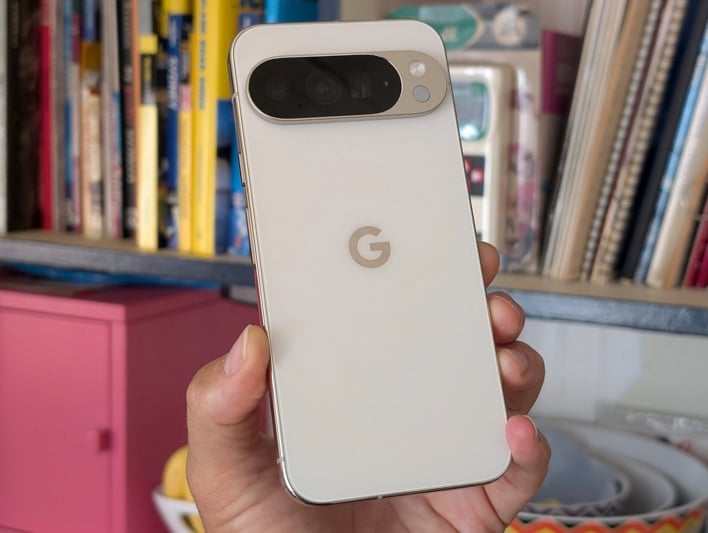
The control and port layout of these three Pixel 10 handsets deviates slightly from the Pixel 9 series. You’ll find the power/lock key and volume rocker on the right side, and nothing on the left. The bottom edge is home to the USB Type-C port (USB 3.2), which is flanked by a pair of grilles for the main speaker and primary mic. US models of the Pixel 10 series lack a SIM tray, which is otherwise located on top, next to the secondary mic.
It’s extremely disappointing that Google chose to follow in Apple’s footsteps and make the Pixel 10, 10 Pro, and 10 Pro XL eSIM only in the US (the Pixel 10 Pro Fold still features a SIM tray). Apple made the terrible decision to remove SIM trays from its US-market iPhones, and only support eSIMs, starting with the iPhone 14 series. Google’s decision sets a precedent which will could result in Samsung following suit.
Pixel 10 Specs And Features
| Processing & 5G Platform | Google Tensor G5, Exynos Modem 5400 |
| Display | 6.3″ 1080p LTPS OLED, 2424×1080 resolution, 120Hz |
| Memory | 12GB |
| Storage | 128GB (UFS 3.1), 256GB (UFS 4.0) |
| Rear-Facing
Cameras |
48MP
f/1.7 Main OIS, dual-pixel PDAF – 13MP f/2.2 120º Ultra-Wide PDAF – 10.8MP f/3.1 5x Periscope Telephoto OIS, dual-pixel PDAF |
| Front-Facing
Cameras |
10.5MP, f/2.2 Ultra-Wide PDAF |
| Video
Recording |
Up
to 4K @ 60fps, 1080p @ 60fps, 1080p slow-mo |
| Battery | 4970mAh, 30W wired charging, 15W wireless charging, Qi2 with magnets |
| OS | Android 16 With Pixel UI |
| Dimensions | 152.8 x 72 x 8.6mm |
| Weight | 204 grams |
| Connectivity | 802.11ax
Wi-Fi 6e, Bluetooth 6.0+LE, NFC, USB-C 3.2, LTE, 5G (sub-6GHz and mmWave), eSIM only |
| Colors | Indigo, Frost, Lemongrass, Obsidian |
| Pricing | Find the Google Pixel 10 @ Amazon, starting at $799 |
Pixel 10 Pro Specs And Features
| Processing & 5G Platform | Google Tensor G5, Exynos Modem 5400 |
| Display | 6.3″ 1.5k LTPO OLED, 2856 x 1280 resolution, 1-120Hz |
| Memory | 16GB |
| Storage | 128GB (UFS 3.1), 256GB (UFS 4.0), 512GB and 1TB (Zoned UFS) |
| Rear-Facing
Cameras |
50MP f/1.7 Main OIS, dual-pixel PDAF – 48MP f/1.7 123º Ultra-Wide dual-pixel PDAF – 48MP f/2.8 5x Periscope Telephoto OIS, dual-pixel PDAF |
| Front-Facing
Cameras |
42MP, f/2.2 Ultra-Wide PDAF |
| Video
Recording |
Up
to 8K @ 30fps, 4K @ 60fps, 1080p @ 60fps, 1080p slow-mo |
| Battery | 4870mAh, 30W wired charging, 15W wireless charging, Qi2 with magnets |
| OS | Android 16 With Pixel UI |
| Dimensions | 152.8 x 72 x 8.5mm |
| Weight | 207 grams |
| Connectivity | 802.11be
Wi-Fi 7, Bluetooth 6.0+LE, NFC, UWB, USB-C 3.2, LTE, 5G (sub-6GHz and mmWave), eSIM only |
| Colors | Moonstone, Jade, Porcelain, Obsidian |
| Pricing | Find the Google Pixel 10 Pro @ Amazon, starting at $999 |
Pixel 10 Pro XL Specs And Features
| Processing & 5G Platform | Google Tensor G5, Exynos Modem 5400 |
| Display | 6.8″ 2k LTPO OLED, 2992 x 1344 resolution, 1-120Hz |
| Memory | 16GB |
| Storage | 256GB (UFS 4.0), 512GB and 1TB (Zoned UFS) |
| Rear-Facing
Cameras |
50MP f/1.7 Main OIS, dual-pixel PDAF – 48MP f/1.7 123º Ultra-Wide dual-pixel PDAF – 48MP f/2.8 5x Periscope Telephoto OIS, dual-pixel PDAF |
| Front-Facing
Cameras |
42MP, f/2.2 Ultra-Wide PDAF |
| Video
Recording |
Up
to 8K @ 30fps, 4K @ 60fps, 1080p @ 60fps, 1080p slow-mo |
| Battery | 5200mAh, 45W wired charging, 25W wireless charging, Qi2 with magnets |
| OS | Android 16 With Pixel UI |
| Dimensions | 162.8 x 76.6 x 8.5mm |
| Weight | 232 grams |
| Connectivity | 802.11be
Wi-Fi 7, Bluetooth 6.0+LE, NFC, UWB, USB-C 3.2, LTE, 5G (sub-6GHz and mmWave), eSIM only |
| Colors | Moonstone, Jade, Porcelain, Obsidian |
| Pricing | Find the Google Pixel 10 Pro XL @ Amazon, starting at $1199 |
Pixel 10 Series Display Quality
The Pixel 10 boasts a 6.3-inch FHD+ (2424 x 1080 pixels, 422ppi) LTPS OLED display with a 20:9 aspect ratio, a 120Hz refresh rate, and HDR10+ support. It’s pretty much identical to the Pixel 9’s screen, but brighter (3000 nits peak vs. 2700).
Meanwhile, the Pixel 10 Pro and 10 Pro XL have very similar 6.3- and 6.8-inch (2856 x 1280 pixels, 495ppi and 2992 x 1344 pixels, 486ppi) LTPO OLED displays to last year’s Pixel 9 Pro and 9 Pro XL. These two screens have the same 20:9 aspect ratio, 120Hz adaptive refresh rate, and HDR10+ support as before, but are now even brighter (3300 nits peak vs. 3000).
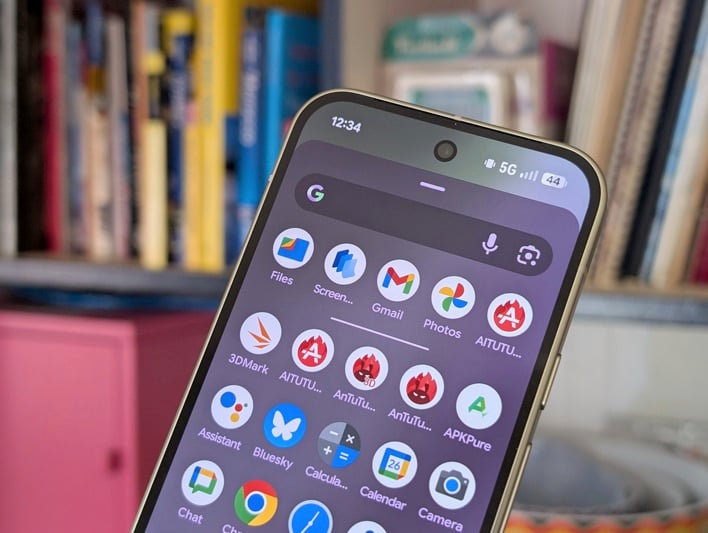
All three panels are covered in Gorilla Glass Victus 2, have reasonably thin bezels, and feature a small punch hole at the top center for the selfie camera. In all, these are lovely displays, with punchy colors, inky blacks, wide viewing angles, and superior outdoor visibility.
Pixel 10 Series Camera Performance And Image Quality
On the imaging front, the Pixel 10 Pro and 10 Pro XL inherit all four cameras from last year’s Pixel 9 Pro and 9 Pro XL. These consist of a 50MP f/1.7 25mm (1/1.31-inch 1.2-micron) main shooter with dual-pixel PDAF and OIS, a 48P f/1/7 120-degree (1/2.55-inch) ultrawide with dual-pixel PDAF, a 48MP f/2.8 113mm (1/2.55-inch) 5x periscope telephoto with dual-pixel PDAF and OIS, and a 42MP f/2.2 17mm ultrawide selfie camera with PDAF.
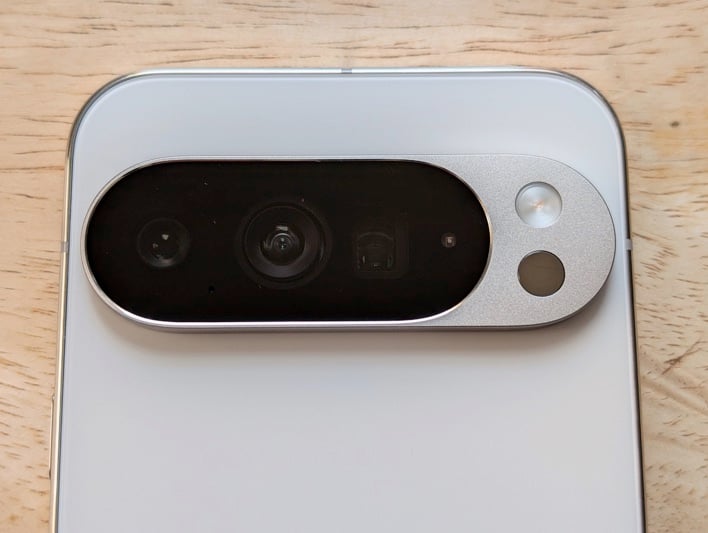
The Pixel 10 gains a telephoto lens at the expense of smaller main and ultrawide sensors. Basically, it mixes the 48MP f/1.7 25mm (1/2-inch 0.8-micron) main shooter with dual-pixel PDAF and OIS, plus the 13MP f/2.2 120-degree (1/3.1-inch 1.12-micron) ultrawide with PDAF from the Pixel 9a with the 10.8MP f/3.1 112mm (1/3.2-inch 1.22-micron) 5x periscope telephoto with dual-pixel PDAF and OIS from the Pixel 9 Pro Fold.


50x Pro Res Zoom at night

Center: 100x standard zoom – Right: 100x Pro Res Zoom – Note the artifacts in the text
Meanwhile, the base Pixel 10 is no slouch in the zooming department. It tops out at 20x magnification using Google’s Super Res Zoom algorithm. As you’d expect, the 50MP, 48MP, and 42MP sensors on these three Pixel 10 phones support 4-to-1 pixel binning, which combines four smaller nearby pixels into one larger pixel and outputs 12.5MP, 12MP, and 10MP images for better dynamic range and low-light performance.
The Pixel 10 offers a rich set of photo modes, which include portrait, night (called Night Sight), RAW support, astrophotography, long exposure, and Action Pan (motion blur). These are available on all four shooters. Macro and Add Me (merges two pictures to add the photographer in group photos, now works with pets) are only supported on the main camera. Panorama is available on both the main shooter and the telephoto.









When it comes to video, the Pixel 10 captures stabilized video (with stereo audio) at up to 4k 60fps with all four shooters. Video modes include slow motion (main only, 1080p 240fps/480fps), time lapse (4k/1080p 30fps), HDR video (main and selfie, 4k 30fps / 1080p 60fps), portrait video (main only, 1080p 30fps), and Cinematic Pan (4k/1080p 30fps). That’s a pretty solid starting point, but there’s even more.
The Pixel 10 Pro and 10 Pro XL crank things up a notch by adding 50MP, 50MP portrait, and 12/50MP pro (manual) photo modes, plus night video (rear only, 4k 60fps), HDR video (all cameras, 4k 60fps), and 8k 30/24fps (rear only) video modes. Overall, you won’t be left wanting by the selection of photo and video modes in the Pixel 10 lineup. We only wish the base Pixel 10 would also offer the pro (manual) shooting mode.






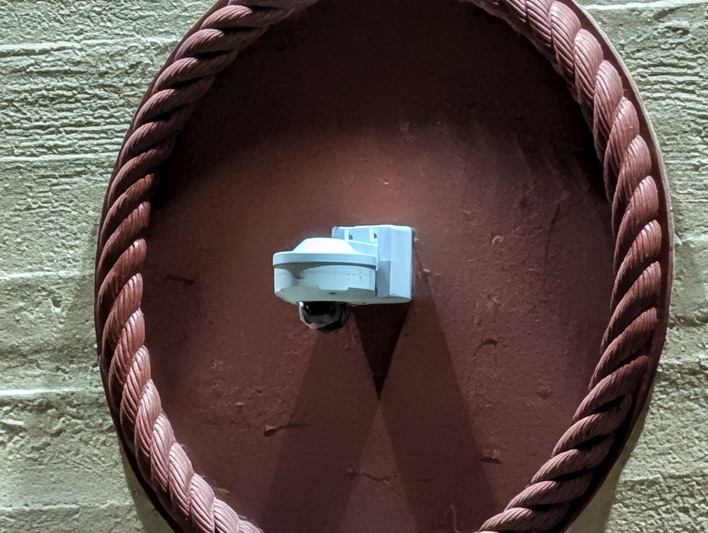
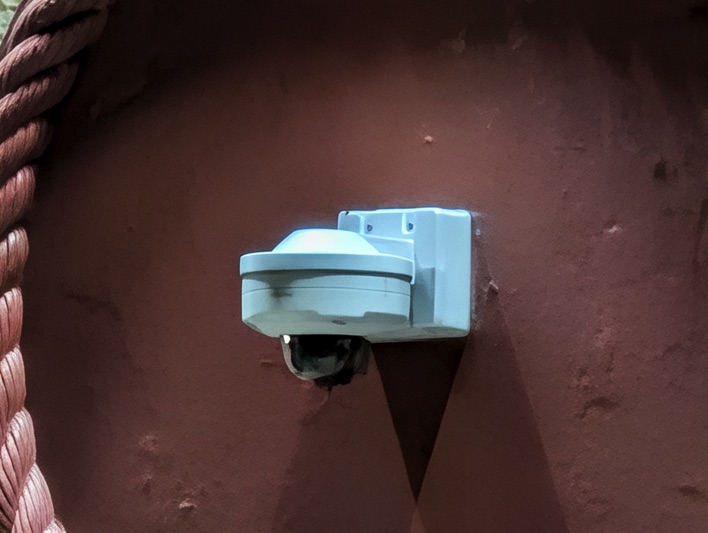
Obviously, these handsets take gorgeous photos. The Pixel 10 lineup clearly leverages all of Google’s imaging expertise, from HDR+ to Night Sight to Super Res Zoom. And the results speak for themselves. Images are sharp, with accurate exposure and realistic colors. Low light performance is impressive, and dynamic range is excellent. But zooming is where these handsets truly shine, especially the Pixel 10 Pro and 10 Pro XL.


10x photos captured with the Pixel 10 look good, and even 20x shots are perfectly usable. The Pixel 10 Pro and 10 Pro XL can easily zoom to 20x with decent results, and most pictures shot at x30 or beyond are fine thanks to Pro Res Zoom. Selfies are beautiful too, though we think Samsung still does a better job with portrait mode. Video recording is competitive but overall, its quality still subjectively falls behind the iPhone.
Next up: audio fidelity, general performance, and battery life results…