
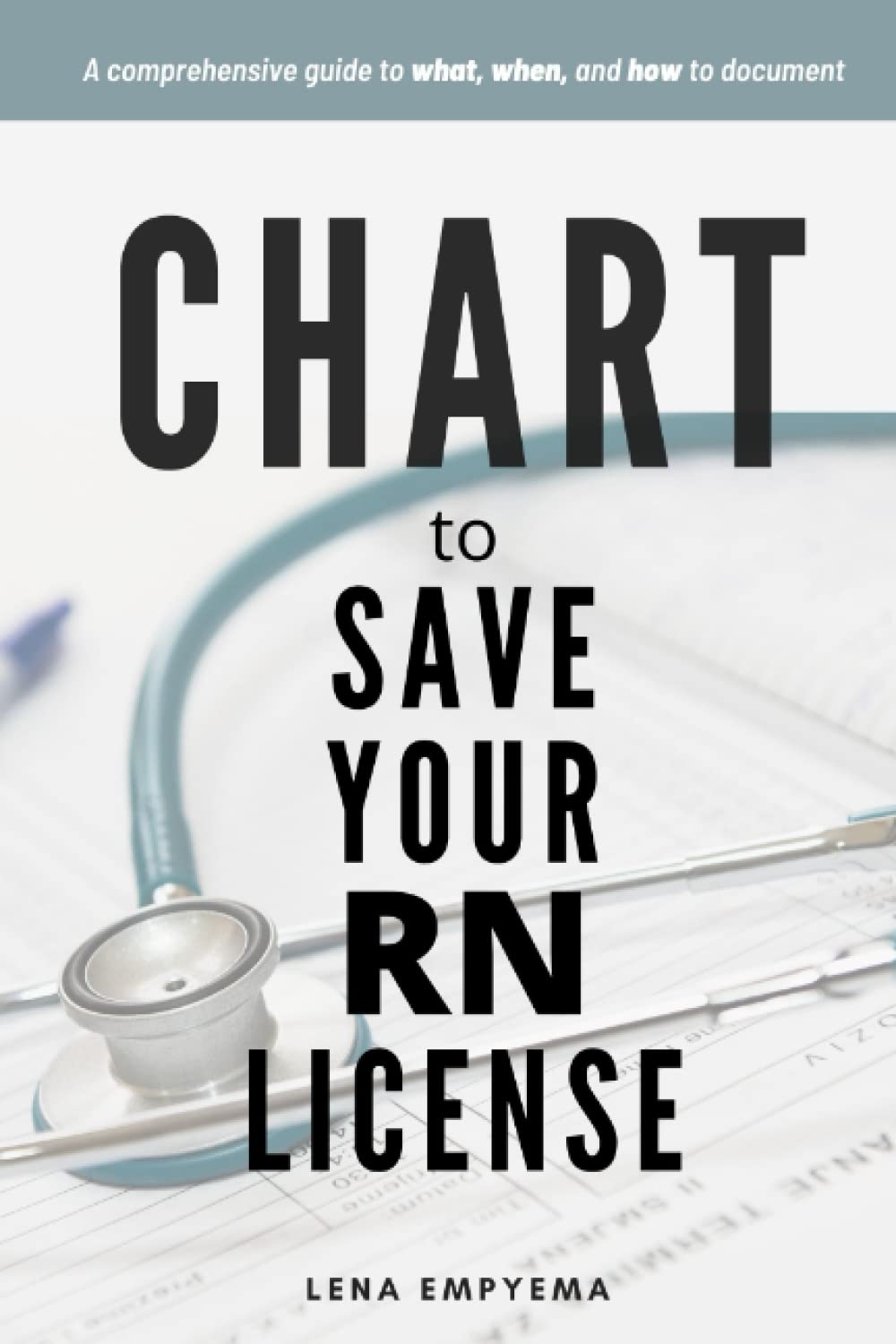
Chart to Save Your RN License: A Comprehensive Guide to What, When, and How to Document for Nurses
€10
Price: $9.99
(as of Oct 02, 2025 12:28:21 UTC – Details)
You can be an excellent nurse in the clinical setting and still fail to prove that you are an excellent nurse if your documentation is inadequate.
Having worked in a variety of inpatient and outpatient settings, I understand the obstacles nurses face. There’s just not time, nor do nurses have the mental energy to meticulously document every little thing on top of the rest of their to-do list. That’s part of why I became passionate about documentation education. It doesn’t have to be an overwhelming, endless challenge to chart exhaustively in hopes that you enter enough data into the chart to defend yourself one day. Rather, leveraging the most critical data, knowing how to format notes and exactly what to say, and when to spend five minutes dumping information into the chart can be learned skills that make documentation faster, easier, and less stressful, while doing a better job of defending your actions.
The Importance of Documentation & Overcoming ObstaclesPurpose(s) of DocumentationDefensive ChartingObstacles Impacting Quality of Medical RecordOvercoming ObstaclesLegal Responsibilities of the NurseDuties of the NurseNurse Practice ActsDuties of the HospitalHospital Policy vs. State Board of Nursing RegulationsReasonable PrudenceFailure to Fulfill (Document) ResponsibilitiesFulfilling Responsibilities vs. Documenting ResponsibilitiesWhat if Responsibilities Aren’t Fulfilled?Mistakes HappenProfessional Liability InsuranceMalpracticeMedical NegligenceActing with MaliceFraudWhat Happens When a Nurse is Charged with Malpractice?What to Do if You Receive Notification of a ClaimCommon Charting Mistakes & How to Avoid ThemThe Most Common ErrorsCharting By Exception & Charting to Capture Minimal Data“But I’ve Always Charted This Way, and Nothing Bad Has Happened Yet…”What You Should Be ChartingHow and What to ChartQuick Glance Charting ChecklistsWhat is a Timely Manner?Documenting AssessmentsSample Focused Assessment CriteriaSharing the ResponsibilityModifying Electronic DataAbbreviationsStanding OrdersEarly Warning Systems Scores & ScalesInformed ConsentSpecial CircumstancesPaper ChartingWriting an Incident ReportPatient Leaving AMAPatient Threatening to Sue YouIdentifying Patient BelongingsAnother Member of the Team is Not Documenting CorrectlyRestraintsDefective EquipmentSuspected AbusePatient Requesting to View Their EMR on Hospital ComputerNarrative NotesWhen & How to Write NotesOne Note or Several Notes?Daily Narrative NotesExamples of Common Notes Written As-NeededHow to Title Narrative NotesHow to Format NotesUsing Patient Names in NotesLength of NotesCreate a TemplateTips for Less Stress When ChartingBONUS: How I Chart on a “Typical” ShiftABOUT THE AUTHOR:
I’m Andrea, RN-MSN. Perfecting my own documentation and working to find concrete guidelines to share with my fellow nurses has become my passion. As I gained more knowledge and researched the dusty, forgotten corners of the internet for obscure evidence-based practice and case studies, becoming a subject matter expert on nursing documentation lit a spark because sharing this information helps empower nurses to understand exactly what should appear in their patient charts, where, when it should entered, and how it should be phrased.
ASIN : B09CGHRXT2
Publisher : Independently published
Publication date : August 11, 2021
Language : English
Print length : 176 pages
ISBN-13 : 979-8548570581
Item Weight : 8.6 ounces
Dimensions : 6 x 0.4 x 9 inches
Best Sellers Rank: #46,788 in Books (See Top 100 in Books) #6 in Nursing Reference (Books) #13 in Medical History & Records (Books)
Customer Reviews: 4.2 4.2 out of 5 stars 238 ratings var dpAcrHasRegisteredArcLinkClickAction; P.when(‘A’, ‘ready’).execute(function(A) { if (dpAcrHasRegisteredArcLinkClickAction !== true) { dpAcrHasRegisteredArcLinkClickAction = true; A.declarative( ‘acrLink-click-metrics’, ‘click’, { “allowLinkDefault”: true }, function (event) { if (window.ue) { ue.count(“acrLinkClickCount”, (ue.count(“acrLinkClickCount”) || 0) + 1); } } ); } }); P.when(‘A’, ‘cf’).execute(function(A) { A.declarative(‘acrStarsLink-click-metrics’, ‘click’, { “allowLinkDefault” : true }, function(event){ if(window.ue) { ue.count(“acrStarsLinkWithPopoverClickCount”, (ue.count(“acrStarsLinkWithPopoverClickCount”) || 0) + 1); } }); });
8 reviews for Chart to Save Your RN License: A Comprehensive Guide to What, When, and How to Document for Nurses
Add a review
Related Products

![LibreOffice v4.3 for PC [Open Source Download]](https://m.media-amazon.com/images/I/41uovfMTo7L._AC_.jpg)



€10
DeeDee –
Good book for advice, but not many examples
This book gives a lot of good advice. As a new nurse, Iâve looked through this book a couple of times as Iâve gotten used to charting, because I pick up on something different every time I look through it. It does give a few examples, too, but if you are looking for a lot of actual charting examples, this is not the book. Although it does have a few, its main goal is advice.
Dlaniger –
Highly recommended for all nursing professionals.
Chart to Save Your RN Licenseâ is an essential guide for any registered nurse seeking to protect their professional license through proper documentation. The book offers clear, practical advice on what to document, when to document it, and how to do so in a legally sound and patient-focused way. It breaks down complex legal and professional expectations into easy-to-follow steps, making it ideal for both new and experienced nurses.What sets this guide apart is its real-world approachâusing relatable scenarios and examples to highlight common documentation pitfalls and how to avoid them. It not only enhances charting accuracy but also builds confidence in handling high-risk situations that could potentially lead to legal or disciplinary action.Whether youâre working in a hospital, clinic, or long-term care setting, this book is a must-have resource to help safeguard your career and ensure youâre meeting the highest standards of nursing documentation.
Cindy –
Good points
Nursing students might benefit from many of these points. They tend to like to add their interpretation of assessment findings. I have seen a sudden increase in charting of “will continue to monitor”. It always bothered me, now I know why! Thank you!
Anne-Marie R. –
Great starter book
Great starter book.
Kat –
Meh
I thought this book would give EXAMPLES on what/how to chart as a new grad nurse. It was a book that focused on legal and insight (which was taught in Nursing school) I need to know what to type when a person comes in that can’t breath, so I don’t get sued, fired, or audited. I don’t recommend this book. It’s not what I thought it would be
Benito Flores –
Good book
Short and to the point but not too much indepth
Christian Vives –
Buenos detalles sobre la documentación
Muy practico el libro
Michelle –
RN back in the game
As a RN that has took some time off this has been a great refresher on documentation.