Covid inquiry live: children paid ‘huge price’ to protect rest of society in pandemic, says Johnson | Covid inquiry

Check out our latest products
![[Upgraded] USB Computer /Laptop Speaker with Stereo Sound & Enhanced Bass, Portable Mini Sound Bar for Windows PCs, Desktop Computer and Laptops](https://m.media-amazon.com/images/I/61NAayKmVIL._AC_SL1500_.jpg)


Johnson: children were ‘paying a huge price’ to protect the rest of society
Boris Johnson is now being asked “whether children’s interests were sufficiently well represented, when you made those decisions.”
It is being put to him by Clair Dobbin KC that the DfE did not have a “seat at the table” at crucial moments.
She is trying to understand from the prime minister if decisions were being made at cabinet, or decisions were being made by Johnson and then communicated to ministers. Gavin Williamson in his evidence appears to have implied that he was blind-sided by an annoucement about primary schools reopening.
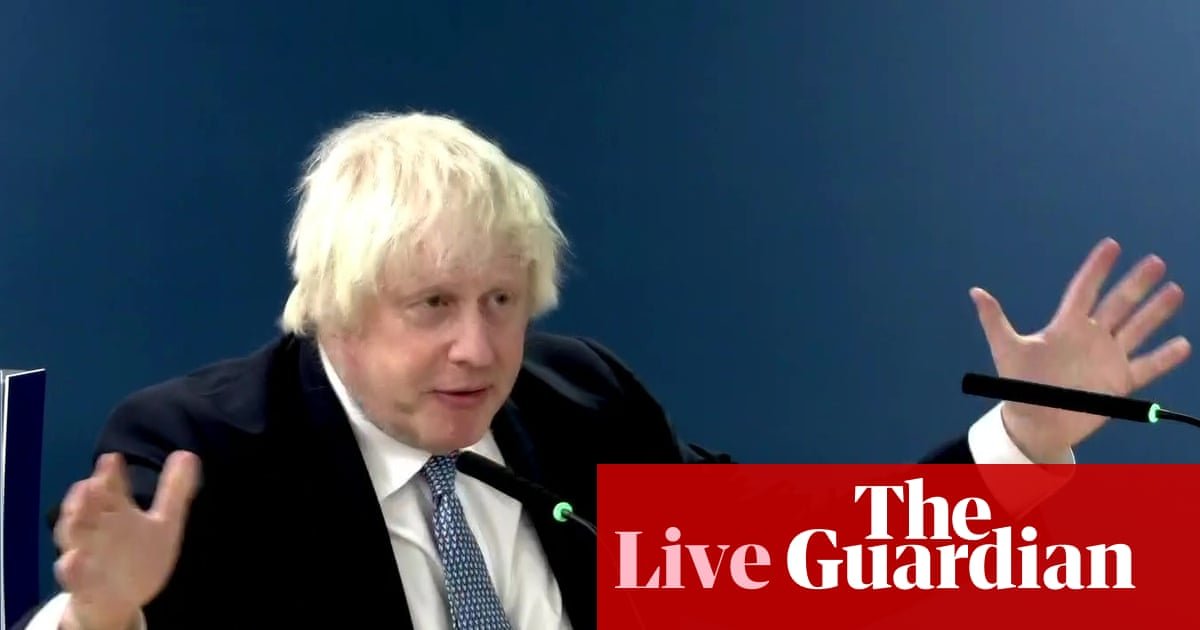
Johnson speaks about the sacrifice children were making, telling the Covid inquiry:
It felt to me as though children who are not particularly vulnerable to Covid were paying a huge, huge price to protect the rest of society. And it was an awful, awful thing. As I said, I wish it had been otherwise. I wish we could have found another solution.
Johnson has a slight dig at Williamson’s evidence, saying “I’m afraid I don’t remember the details of that. It seems a bit paradoxical to be criticised both for wanting to close schools and wanting to get them open.”
Williamson contended in his evidence that Johnson had undermined confidence in the DfE from schools, because the prime minister was flagging to families and parents that kids could go back to school, when schools knew that because of social distancing requirements they could not cope with full schools.
This passage seems rather bogged down in the personal political gripes between Johnson and Williamson.
Key events
Liberal Democrat health spokesperson Caroline Voaden has also responded to Boris Johnson’s Covid inquiry evidence, in particular addressing the moment when the former prime minister suggested Gavin Williamson had made a heroic effort as education secretary during the pandemic. She said:
Johnson should be embarrassed to call Gavin Williamson’s efforts ‘heroic’.
It’s an insult to the true heroes of the Covid pandemic: the teachers and doctors, nurses and key workers who put their lives on the line to keep crucial public services going.
From duff algorithms that ruined young people’s dreams of further education, to crucial development lost in early years, Johnson’s effort to gloss over his government’s total failure to plan for schools in 2020 is yet another kick in the teeth to the British public.
Dan Paskins, executive director of UK impact at Save the Children UK, has responded to Boris Johnson’s evidence at the Covid inquiry with a call to embed the UN Convention on the Rights of the Child into UK law.
In a statement, he said:
The actions of those in power during the pandemic damaged a generation of children. Their health, wellbeing, and future prospects all suffered. The poorest and most vulnerable were frequently ignored and no amount of regret will undo the harm that has been done.
Evidence to this inquiry has clearly shown that consideration of children’s rights was absent from decision-making. There was no clear mechanism to protect their interests, and no voice for them in the room. Decisions were rushed, impact assessments neglected, and their needs assumed to mirror adults’. This must never be allowed to happen again.
Summary of Boris Johnson’s evidence to the UK Covid inquiry
Appearing before the UK Covid inquiry in London, former prime minister Boris Johnson has said that lockdown rules were “far too elaborate”, deciding to close schools in January 2021 was “hellishly difficult”, and the consequences of school closures for children and young people had ended up being “on the worst end of my expectations.”
However, he insisted that it was impossible to know if a different course of action would have led to a much wider spread of the virus, and that with little known at the beginning of the pandemic about the impact on children of Covid and how the virus transmitted, at times he felt he had “no option” but to close schools.
A central theme of Johnson’s evidence was conflict with the then-education secretary Gavin Williamson. Williamson claimed in his earlier evidence to the inquiry that he was finding out about decisions on school closures rather than him and the department being involved, and that Johnson’s decisions and announcements were eroding trust between schools and the DfE.
Questioning Johnson, who quit as an MP in disgrace in June 2023, Clair Dobbin KC sought to inderstand why the DfE appeared unready for school closures, and why Johnson still seemed to be seeking advice to support the idea of keeping schools open right up to the last minute before they were closed.
Chair Heather Hallett is asking one final question. She wants to know if Boris Johnson thinks a minister for children would have improved the way the impact of the pandemic affected that particular group.
Johnson says he has thought about this, but the former prime minister questions the value. He tells the inquiry it would involve “another department, another set of civil servants and so on” and that “we’ve seen already … how fractious and difficult it becomes when different ministerial interests start to collide, and we’ve got quite enough around the table on a subject like this.”
Hallett thanks him for his time, and then there is some laughter in the room as Johnson rises to leave as if he has been dismissed, but she hasn’t finished.
He says he means no discourtesy, and likens it to when the speaker stands up at the end of PMQs. “You just belt for it” he says. Hallett tells the inquiry it will resume this afternoon, and Johnson can leave.
Boris Johnson has been asked questions by Kate Beattie, representing organisations that work with disabled people, and Adam Wagner KC who represents clinically vulnerable families.
The thrust of both their questions is to get him to put on record what provision, consideration or care the prime minister took in school closure decisions for these specific groups. Johnson is nothing if not an experienced politician in this kind of situation, and he manages to answer both sets of questions with a lot of words that shed very little light.
Sam Jacobs is asking questions on behalf of the TUC, and brings up the topic of Rishi Sunak’s Eat Out To Help Out. He suggests it was an example of the government not using its “risk budget” to facilitate school attendance, but instead “encouraged significant numbers to socialise in restaurants.”
In reply, Boris Johnson says “Well, it’s a very fair question. I know there’s been a lot of shot and shell directed at Eat Out to Help Out over the last few years.”
He says according to his recollection, the policy was known of by scientific advisers, and the problem is “I think that’s the terrible reality of all these interventions is we don’t know the individual value of any of them.”
He continues by saying “I think that it was felt at the time that given where the R was, and the state of the economy it was reasonable to proceed with Eat Out to Help Out.”
Jacobs asks whether he would question that in retrospect. The former prime minister replies “Well, lots of people have.”
Eat Out to Help Out was launched in August 2020. It allowed diners to claim 50% off more than 160m meals at a cost to the Treasury of about £850m. A study carried out by Thiemo Fetzer, an economist at the University of Warwick, suggested it drove new Covid-19 infections up by between 8 and 17%.
Johnson: intricacy of policies like ‘the rule of six’ were ‘far too elaborate’ during lockdown
Steve Broach KC is representing children’s rights organisations. He is asking Boris Johnson about rules around children playing and if in England they were systematically treated as adults.
The former prime minister says:
I think that you’re making a very fair point about the rules generally. I think that looking back on it all, the whole lockdowns, the intricacy of the rules, the rule of six, the complexity, particularly for children, I think we probably did go too far, and it was, it was far too elaborate. Maybe we could have found a way of of exempting children. It’s a very fair point.
Broach cites examples of people stopping children from taking outside exercise and play. Johnson says:
I’m very sorry to hear that, if there was excessively officious enforcement of rules or misunderstanding of rules by those in authority, then that’s plainly wrong. Children should have been, as my understanding the rules, children should have been allowed to exercise outdoors.
Sarah Hannet KC, representing Long Covid Kids, asks Boris Johnson questions about a piece of advice they government had received. He rather side-steps this by insisting he thinks there is an error in the document they are presenting and it isn’t meant to refer to children.
Clair Dobbin KC says she is coming to her last question on this topic. She says Boris Johnson’s evidence suggests one of his biggest anxieties now is being unsure about the extent to which non-pharmaceutical interventions – like school closures – saved lives compared to the damage caused.
The former prime minister says:
Given the detriment, given the suffering, given the damage, was there another way of reducing the budget of risk? Was there? Was there another thing we could have done? Was there another shot we could have played? And I don’t know the answer to that, nor can I answer.
Nor can I really be certain what would have happened if we’d gone with what Gavin [Williamson] and the DfE wanted on 4 January 2021, and kept going, what would really have happened? I can’t know. None of us can know.
But the predictions were really grim.
That concludes the questions to Boris Johnson by the counsel to the inquiry. He is now being questioned by legal teams representing other core participants.
The inquiry is now talking about education recovery commissioner Kevan Collins, who resigned after the government did not adopt his suggested costed plans for providing education support for children who had missed out on schooling.
Boris Johnson attempts to make the case to the inquiry that he did not believe the proposal offered value for money, and possibly slightly unhelpfully for the current Conservative leadership, suggests that the current government debt situation has been caused not Rachel Reeves’ policies, but by the money Johnson spent during the pandemic. He told the inquiry:
So I had to make a difficult choice, and not for not the first time. We just spent £480bn already on Covid. The country, even now, is struggling with a huge debt burden, which is putting up the cost of living, interest rates, for everybody in this country.
Just to throw another £10bn on something for which the evidential basis is not very strong, is not something that you should normally be be doing.
The difficulty is that we have a very – certainly post-Covid – a very constrained fiscal position. And we have to … the government today has to be mindful of the bond markets. Why is Rachel Reeves continually talking about putting taxes up? It is because if she doesn’t, the international finance will mark Britain down … and if she’s seen to spend too much.
He describes Collins as “a passionate educationalist who whose life is dedicated to trying to secure more more funding from government” who put a plan on the table “with a big number attached to it.”
Johnson says “I’m in a different position. I share [Collins’] desire, but I I’m limited by the position we’re in. And also by the need to be mindful of taxpayer value and, frankly, to get the kids the best outcome.”
Johnson: consequences of school closures were ‘on the worst end of my expectations’
Clair Dobbin KC reads out some evidence to the inquiry from a parent, describing how their son became suicidal after feeling they had missed out on a career opportunity and key moments of their life during lockdown and school closures.
She asks former prime minister Boris Johnson “Do you think the consequences [of school closures] proved to be worse than you anticipated?”
Stumbling over his answer slightly, he tells the Covid inquiry:
That’s a good question. I think that they were certainly as bad as … they were certainly on the, on the … worst end of my expectations … some of the things that happened.
As a reminder the live stream from the inquiry comes with the following content warning: “This module contains references to child death and harm to children through illness, abuse, suicide and crime.”
Boris Johnson suggests he would “respectfully” disagree with Gavin Williamson’s assessment in his evidence. Williamson told the inquiry that he believed schools were closed in January 2021 not because it would have a significant impact on infection rates, but because the government had to be seen to using all the levers at its disposal.
Johnson says “It grieved everybody to have to do it. It is the last thing I wanted to do.”
Clair Dobbin KC suggests Williamson characterised it as a panic decision, and likened it to smashing a Ming vase on the floor for effect. Johnson again says he respectfully disagrees with that assessment.
He says “but the numbers were very difficult to argue with”, adding:
The problem with bringing the schools back, as everybody knows, is that there’s a delay. Because when the virus starts circulating in schools, there’s a delay between between the kids contracting it and then passing it on, and then the the adults being infected. And so you’re storing up potentially very, very big problems.
On the conflict with Williamson, he said:
It was clear to me that because of [the alpha variant], the balance of the argument had shifted. I had no option. I had no option, given the facts as they presented themselves that day. I felt I had no option but to close down and or to prevent the reopening of schools.
Johnson: decision to close schools again in January 2021 was ‘hellishly difficult’
The then education secretary Gavin Williamson’s evidence is cited again. He claimed that on the morning of 4 January 2021 he spoke to the prime minister, and Boris Johnson’s message to him at that point was “about keeping schools open and doing everything to ensure that remained the position,” Clair Dobbin KC says.
She continues to say that Williamson claims in his testimony he told Johnson 85% of schools had opened, but then by lunchtime he was receiving a call to say schools must close. Johnson says he understands how that would be “frustrating” for a secretary of state.
Johnson goes on to say “And I think you’re looking at the reality of the way things have to run in government, and particularly during a pandemic.
“Gavin rightly owned the interests of schools and young people he had to promote. I had the problem of trying to balance the interests of the entire country, and every single potential Covid victim, and it was hellishly difficult.”
“Was it the worst of all worlds then that some primary schools around the country opened on 4 January 2021, only to have to close again that day because of the reversal of position?” Clair Dobbin KC asks Boris Johnson.
“Yes, it was. You know, I’m very sorry to them for them that their efforts were in vain,” he replies.
The former prime minister continues:
Where there other options we could have used, then, at any stage, to to reduce the R, other than closing schools? Was that really the right tool to to use.
Looking back, honestly, I’m not certain, but at the time, it seemed like the only option. The risk was if we had another doubling, we would see a very serious number of fatalities.
Chair Heather Hallett makes a rare interventions, asking Johnson “Why was it that the decision had to wait? That primary schools opened 4 January and then closed that night? Could the decision not have been taken earlier?”
Johnson replies:
Of course, it could have been taken earlier, and it would have looked better and have felt less bumpy to everybody had it been taken earlier. Of course, that’s right. But at the time it wasn’t as obvious to me as it seems now. At the time I was still very much divided.
Boris Johnson is being shown some minutes now, and Clair Dobbin KC is pressing him on, if the prime minister was expecting schools to re-open with a mass testing programme in place on 4 January, why was he asking “fundamental questions” about how the plan was going to work on 28 December.
“To the best of my memory,” he says, “That doesn’t mean that I thought that the plan was necessarily undeliverable. I wanted to make sure that we belt and braced it.”
He said of the idea of mass testing of secondary pupils: “I didn’t think it was such an unreasonable thing to ask. I know it was onerous, but I believe they could.”
Dobbin then cites evidence from permanent secretary at the DfE, Susan Acland-Hood, who told the inquiry she felt the government was asking something deeply unreasonable of schools. “In other words,” Dobbin puts it to Johnson, “the teachers were there to teach the children. They weren’t there to implement a mass testing regime in secondary schools.”
Johnson defends the position by saying that vaccines were yet to come down the track, and “in the second half of 2020 that was the only shot we had. Mass testing was the only way through for the country that I that I could see.”