
Check out our latest products
![[Upgraded] USB Computer /Laptop Speaker with Stereo Sound & Enhanced Bass, Portable Mini Sound Bar for Windows PCs, Desktop Computer and Laptops](https://m.media-amazon.com/images/I/61NAayKmVIL._AC_SL1500_.jpg)


| Samsung Galaxy Z Fold7 – Starting At $1,999, Find It On Amazon The Galaxy Z Fold7 is Samsung’s best folding phone yet. The ultra-thin and light design is outstanding and the software is feature-rich, though its battery life is middling and telephoto performance is lackluster.
|
|||

|


|
||
Despite having pioneered folding phones, Samsung lost its edge over the last few years. By the time the Galaxy Z Fold6 launched last summer, the company was seriously lagging behind Chinese manufacturers like Oppo, Honor, and Xiaomi – and even Google here in the US – when it comes to design and specs. However, the Galaxy Z Fold7 that Samsung recently revealed at its Unpacked event brings the company back into the fold.
But while it now generally matches the competition in terms of thickness (8.9mm folded, 4.2mm unfolded), weight (215g), and form factor, the Z Fold7 lacks the silicon-carbon battery tech and flagship-grade telephoto cameras found in Chinese folding handsets. It also drops support for the S Pen, which is a bummer. This is odd, considering Samsung keeps using the word “ultra” to market the Z Fold7. And then there’s the price: $1,999 is a big price tag. Regardless, aside from its smallish 4,400mAh battery and basic 10MP 3x telephoto lens, did Samsung make any other hardware compromises in the name of thinness and lightness? How does Qualcomm’s Snapdragon 8 Elite perform in such a slim chassis?
And, taking Samsung’s broad ecosystem and feature-rich software into account, is the Galaxy Z Fold7 the new book-style folding phone to beat? As you’ve probably noticed, there’s an Editor’s Choice logo in our summary here above (for good reason), so let’s find out more in our full review.
Galaxy Z Fold7 Hardware, Design, And Build Quality
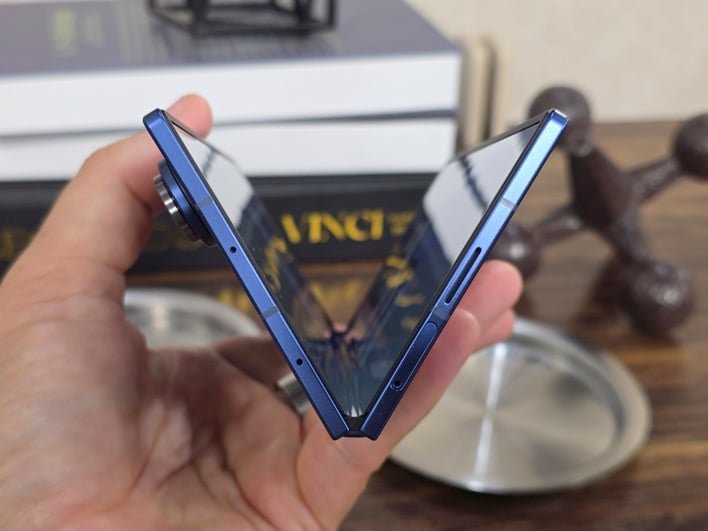
For too long, Samsung made thick, narrow, tall, and awkwardly proportioned book-style folding phones while Chinese manufacturers were striving to make folding phones that look and feel no different than a bar-style flagship when folded. The Galaxy Z Fold7 changes all this. With a thickness of just 8.9mm folded and 4.2mm unfolded, it matches the previous thinness champ, the Oppo Find N5 (successor to the Oppo Find N3 or OnePlus Open).

And at 215g, it weighs slightly less than the Honor Magic V5, the current thinness record holder (217g, 8.8mm folded, 4.1mm unfolded). In fact, the Z Fold7 is even lighter than Samsung’s very own Galaxy S25 Ultra (215 vs. 218g) and is only slightly thicker (8.9 vs. 8.2mm). That’s truly impressive. Besides being slim, the Z Fold7 adopts a regular bar-style form factor when folded thanks to a 6.5-inch cover screen with a standard 21:9 aspect ratio.
It’s hard to convey in words, photos, or even video how incredibly thin and light the Z Fold7 actually is, and how comfortable it is to hold. Just like with the Galaxy S25 Edge, you need to experience this device in person to really understand it. Plus, the Z Fold7’s squared off design looks fantastic. Build and material quality are top notch, and the hinge feels incredibly solid yet silky smooth, and offers just the right amount of resistance.

Speaking of durability, the Z Fold7 is rated IP48 for dust and water resistance, and is made of Advanced Armor Aluminum (frame), titanium alloy (hinge), Gorilla Glass Ceramic 2 (cover screen), and Gorilla Glass Victus 2 (back panel). The main display has grown to 8 inches, and is reinforced with a titanium mesh, significantly reducing the crease while helping protect the folding panel’s new, tougher ultra-thin glass by dispersing stress.
The Z Fold7’s vertical camera pod reverts to the Galaxy Z Fold5’s design, with three silver-rimmed lenses jutting from a pill-shaped island, and the flash mounted to the side, flush with the rear glass. Like with the Galaxy S25 Edge, this camera bump is thicker (about 6mm) then the unopened handset itself, and since it’s mounted in the top left corner of the back panel, the Z Fold7 wobbles like a drunken sailor when placed on a flat surface.

With the Z Fold7 unfolded, you’ll find the volume rocker, and power/lock key (which doubles as a capacitive fingerprint sensor) on the right side, and nothing but antenna bands on the left. The SIM tray, a pair of mics, and one speaker are mounted on the top edge, while the USB Type-C port, another pair of mics, and the other speaker are located along the bottom. Interestingly, there are no visible mmWave 5G antenna windows on the Z Fold7.
You can get the Z Fold7 in four different hues: Blue Shadow, Silver Shadow, Jet-black, and Mint (a Samsung store exclusive). We’re glad Samsung is offering fun colors again because our Blue Shadow review unit is particularly striking.
But, before we continue, don’t miss our hands-on video:
Galaxy Z Fold7 Specs And Features
| CPU Platform |
Qualcomm Snapdragon 8 Elite for Galaxy |
| Display | 8.0″ 2k LTPO Dynamic AMOLED 2x, 2184×1968 res, 1-120Hz + 6.5″ 1080p LTPO Dynamic AMOLED 2x, 2520×1080 res, 1-120Hz |
| Memory | 12/16GB |
| Storage | 256GB/512GB/1TB UFS 4.0 |
| Rear-Facing
Cameras |
200MP 1/1.4” f/1.7 Main OIS, Omni-Directional PDAF – 12MP f/2.2 120º Ultra-Wide PDAF – 10MP f/2.4 3x Telephoto OIS, PDAF |
| Front-Facing
Cameras |
10MP f/2.2 18mm (inner) – 10MP f/2.2 24mm (outer) |
| Video
Recording |
Up
to 8K @ 30fps, 4K @ 60fps, 1080p @ 120fps, 1080p slow-mo |
| Battery | 4,400mAh, 25W wired charging, 15W wireless charging, 4.5W reverse wireless |
| OS | Android 16 with One UI 8 |
| Dimensions | Unfolded: 158.4 x 143.2 x 4.2mm – Folded: 158.4 x 72.8 x 8.9mm |
| Weight | 215 grams |
| Connectivity | 802.11be Wi-Fi 7, Bluetooth 5.4+LE, NFC, UWB, USB-C, LTE, 5G (sub-6GHz and mmWave) |
| Colors | Blue Shadow, Silver Shadow, Jet-black, Mint |
| Pricing: | Find The Galaxy Z Fold7, Starting At $1999 |
Galaxy Z Fold7 Display Quality
Samsung has upgraded the Galaxy Z Fold7’s screens for 2025. You’re now getting a 6.5-inch FHD+ (2520 x 1080 pixels. 422ppi) cover display with a standard 21:9 aspect ratio, alongside an almost square 8-inch QXGA+ (2184 x 1968 pixels, 368ppi) folding main screen. These are LTPO AMOLED panels (Dynamic AMOLED 2X) with a 120Hz adaptive refresh rate, HDR10+ support, and 2600 nits of very punchy peak brightness.

As you’d expect from Samsung, these are gorgeous displays – with vibrant colors, deep blacks, and broad viewing angles – that are bright enough to read in direct sunlight. The folding panel’s crease is much less noticeable than before, besting the competition. Both screens feature slim, even bezels all the way around, and 10MP shooters behind punch holes, putting an end to the 4MP UDC (under display camera) from previous generations.
Unfortunately, the Z Fold7 also lacks S Pen support. Samsung claims that the ultra-thin design doesn’t leave enough space to include a digitizer, but the Oppo Find N5 is about the same thickness as the Z Fold7, and does support an active stylus on both its inner and outer screens.
Galaxy Z Fold7 Camera Performance And Image Quality
Samsung’s Galaxy Z Fold7 boasts the same shooters as the Galaxy S25 Edge, but supplemented by the Galaxy Z Fold6’s telephoto. Sadly, that 3x telephoto doesn’t make a big difference. The Z Fold7 struggles just as much as the S25 Edge when zooming. On the plus side, that 200MP main sensor is solid, and the Snapdragon 8 Elite’s powerful ISP is more than capable of squeezing the most image quality from these cameras.

Obviously, photos and videos shot with the Z Fold7 are similar to those taken with the S25 Edge, and telephoto performance mirrors last year’s Z Fold6. While that’s fine, it’s no match for what the Chinese competition can achieve – or even the OnePlus Open from 2023 – especially when zooming. It’s certainly not “ultra”. Even Google’s Pixel Pro 9 Fold outperforms the Z Fold7, despite also having small ultrawide and telephoto sensors.

The Z Fold7 packs the same 200MP f/1.7 0.6-micron main shooter with dual-pixel PDAF and OIS (1/1.3-inch Samsung ISOCELL HP2) and 12MP f/2.2 1.4-micron 120-degree ultrawide with dual-pixel PDAF as the S25 Edge. It also inherits the 10MP f/2.4 1.0-micron 3x telephoto with PDAF and OIS from the Z Fold6, and features a pair of 10MP f/2.2 1.12-micron selfie cameras in the inner screen (18mm, ultrawide) and outer display (24mm, wide).


As we mentioned above, Samsung chose to replace the middling 4MP UDC (under display camera) from the inner screen with a proper 10MP ultrawide shooter behind a punch hole, which is a big improvement. Overall, the Z Fold7 takes excellent photos and videos, with sharp detail, punchy colors, accurate exposure, decent dynamic range, and superior low-light performance. Selfies are beautiful and Samsung’s portrait mode remains best-in-class.
Zooming is where things fall apart. While on paper, the Z Fold7 tops out at 30x magnification (3x optical plus 10x digital), it doesn’t perform any better than the Galaxy S25 Edge, which doesn’t have a telephoto camera and tops out at 10x (digital) magnification. The Z Fold7’s 10MP 3x telephoto doesn’t seem to improve zoom performance. Samsung isn’t using sensor fusion, or any clever AI zoom algorithms like what we saw on the OnePlus 13.


In practice, 10x shots are usable but suffer from a noticeable loss in detail. Zooming beyond 10x simply results in disappointing images vs. the competition and non-folding flagships. Even pictures captured at the telephoto’s native 3x magnification are often softer than expected, and we’ve experienced problems focusing with the telephoto in low light. By contrast, the Oppo Find N5’s 50MP 3x periscope telephoto simply delivers nicer photos at 10x and beyond.


Shooting modes include macro, portrait, night, pro, 200/50MP (main only), panorama, food, macro video (up to 4k 60fps), ultra steady (1440p/1080p 60/30fps), portrait video (4k/1080p 30fps), pro video (8k 30/24fps / 4k 60/30/24fps / 1080p 120/60/30/24fps), slow motion (4k 120fps, 1080p 240/120fps), hyperlapse (4k/1080p 30fps), Single Take, and Dual Rec (4k/1080p 30fps) – which lets you combine any two of up to four cameras.


The Z Fold7 records stabilized video at up to 8k 30fps (main) and 4k 60fps (all shooters) with 10-bit HDR and LOG support, and stereo or 360-degree audio (using compatible headphones and earbuds). Like with other Samsung flagships, the Camera Assistant app allows you to fine tune imaging settings, and the Expert RAW app enables additional camera features, including RAW support, a 24MP mode, and astrophotography.
Next up: audio fidelity, general performance, and battery life results…