
Gaza ceasefire live: Red Cross warns of ‘massive challenge’ in returning bodies of hostages as key truce issues remain | Israel

Check out our latest products
![[Upgraded] USB Computer /Laptop Speaker with Stereo Sound & Enhanced Bass, Portable Mini Sound Bar for Windows PCs, Desktop Computer and Laptops](https://m.media-amazon.com/images/I/61NAayKmVIL._AC_SL1500_.jpg)


Returning hostage bodies from Gaza may take time, Red Cross says
The ICRC has acknowledged that it will take time to hand over the remains of Israeli hostages in Gaza, calling it a “massive challenge” given the difficulties of finding bodies amid the territory’s rubble.
“That’s an even bigger challenge than having the people alive being released. That’s a massive challenge,” the ICRC’s spokesperson Christian Cardon was quoted by Reuters as having said.
“I think that there is clearly a risk that that will take much more time. What are we telling the parties is that that should be their top priority,” he said.
Cardon added that it could take days or weeks and that there was a possibility they were never found.
Key events
UN says countries are willing to fund Gaza’s $70bn reconstruction
There are promising early indications from countries, including the US as well as Arab and European states, about their willingness to contribute to the $70bn (£53bn) cost of rebuilding Gaza, a UN development programme official has said.
“We’ve had very good indications already,” UNDP’s Jaco Cilliers told reporters at a press conference in Geneva, without giving details.
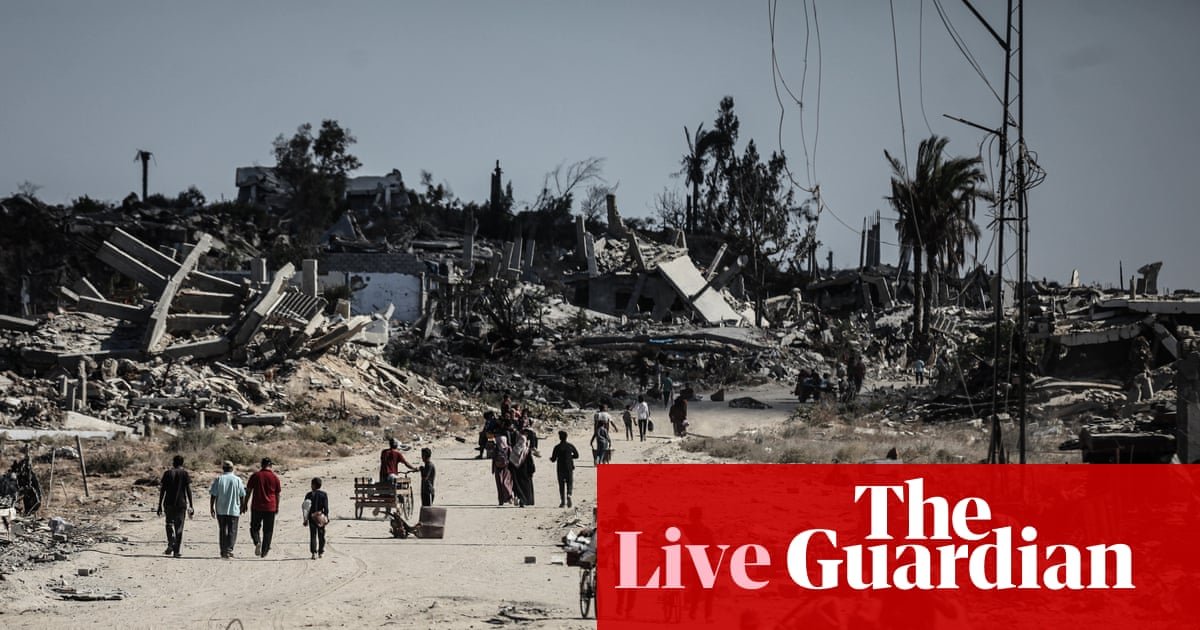
He estimated that Israel’s war had generated at least 55 million tons of rubble.
The latest UN data taken from satellite imagery between 22 September and 23, showed about 80% of all structures in Gaza City are damaged, including about 17,734 buildings that have been completely destroyed.
UNDP says it has started some clearance amid the rubble, but unexploded ordnance is hampering the pace of its work.
UN investigators said last month that they had determined that Israel has committed “genocide” in Gaza since October 2023, with the “intent to destroy the Palestinians” in the territory.
The UN investigators cited examples of the scale of the Israeli killings, aid blockages, forced displacement and the destruction of a fertility clinic to back up its genocide finding.
The 1948 UN Genocide Convention defines genocide as crimes committed “with intent to destroy, in whole or in part, a national, ethnic, racial or religious group, as such”. To count as genocide, at least one of five acts must have occurred.
The UN commission found that Israel had committed four of them: killing; causing serious bodily or mental harm; deliberately inflicting conditions of life calculated to bring about the destruction of the Palestinians in whole or in part; and imposing measures intended to prevent births.
Israel is fighting allegations at the world’s top court, the international court of justice, of committing genocide in Gaza. Israel has denied the claims.
Spanish prime minister says ceasefire agreement should not mean impunity for Gaza ‘genocide’
Spanish prime minister Pedro Sánchez has said the Israel-Hamas ceasefire agreement must not come at the expense of holding accountable those responsible for the “genocide” in Gaza.
“Peace cannot mean forgetting; it cannot mean impunity,” he said during an interview with Cadena Ser radio.
“Those who were key actors in the genocide perpetrated in Gaza must answer to justice, there can be no impunity,” he added when asked about the possibility of legal proceedings against Israeli prime minister Benjamin Netanyahu, who has an international criminal court arrest warrant against him for alleged crimes including starvation as a method of warfare.
Qatar’s foreign ministry spokesperson Majed al-Ansari has been speaking to Fox News about the ceasefire agreement. Doha, along with Cairo and Washington, has been a key mediator between Israel and Hamas during the Israeli assault.
Asked by Fox News about the prospects of moving to phase 2 of the US-brokered agreement, al-Ansari said: “We had delayed a lot of discussions around stage one … in order to make sure stage one happens.
“The difficult discussions have begun, as to how it will look like (phase 2) to secure Gaza, administer it and ensure that there is no war again.”
The last Gaza ceasefire broke down after two months in March when Israel resumed its deadly assault. There are fears that this truce may also prove precarious, especially given the resistance from the far-right wing of the Benjamin Netanyahu’s fragile coalition.
Many Palestinian people have faced starvation and have had to endure extreme hunger as the UN and other organisations have faced massive logistical obstacles including widespread looting, Israeli bombardments, Israel’s administrative restrictions and bureaucracy and infrastructure damaged by Israeli attacks within Gaza.
Aid agencies said, in line with the terms in the ceasefire agreement, that they are preparing to “flood” Gaza with food and other essential supplies.
At least 600 trucks are needed every day – at a minimum – to start addressing Gaza’s dire humanitarian crisis, according to the UN.
Palestinian people in Gaza have received only a trickle of aid over recent months. During the war, Israel shut down entry and exit routes, largely blocking off food and medicine, which in turn caused a famine in large parts of Gaza.
Tedros Adhanom Ghebreyesus, head of the World Health Organization (WHO), said they have been scaling up their operations since the ceasefire took hold, including bringing eight trucks of medical supplies – which included insulin and lab supplies – into the region.
He was quoted by the BBC as having said:
Gaza’s health system must be rehabilitated and rebuilt. This crisis gives us the opportunity to rebuild it better – stronger, fairer and centred on people’s needs. The best medicine is peace.
Returning hostage bodies from Gaza may take time, Red Cross says
The ICRC has acknowledged that it will take time to hand over the remains of Israeli hostages in Gaza, calling it a “massive challenge” given the difficulties of finding bodies amid the territory’s rubble.
“That’s an even bigger challenge than having the people alive being released. That’s a massive challenge,” the ICRC’s spokesperson Christian Cardon was quoted by Reuters as having said.
“I think that there is clearly a risk that that will take much more time. What are we telling the parties is that that should be their top priority,” he said.
Cardon added that it could take days or weeks and that there was a possibility they were never found.
The International Committee of the Red Cross (ICRC), which has acted as a neutral intermediary in the handovers of hostages, has called for “the dignified management of the deceased” as the families of 24 Israeli hostages anxiously wait for the release of their bodies by Hamas from Gaza.
In a news release, the ICRC said its teams are ensuring the deceased are “handled with respect, including by providing body bags, refrigerated vehicles and deploying additional staff to facilitate this process”.
“Families grieving the loss of their loved ones have already endured unimaginable pain. All parties must ensure that the return of human remains is done under dignified conditions, and uphold dignity and humanity.”
The ICRC said the return of the deceased hostages to grieving Israeli families is “an essential element” for the full implementation of the US brokered agreement.
French President Emmanuel Macron spoke to journalists before departing from the Egyptian Red Sea resort of Sharm el-Sheikh following yesterday’s summit.
He warned there was still a risk of terror attacks and destabilisation in Gaza by Hamas despite the positive developments from the first stages of the US brokered ceasefire plan.
“I’m concerned because we know how things work with terrorist groups,” Macron was quoted by Hareetz as having replied to a journalist’s question on whether he was concerned that Hamas would fill the power vacuum in Gaza.
“You don’t dismantle a terrorist group with thousands of fighters, tunnels and this kind of weaponry overnight,” he said.
Here are some of the latest images being sent to us over the newswires from Gaza as uncertainty hangs over the next stages of the ceasefire plan:
Despite the ceasefire agreement, a medical source told Palestinian news agency Wafa today that four people were killed when Israeli drones fired at residents inspecting their homes in Gaza’s eastern Shejaiya neighbourhood. We have not yet been able to independently verify this information.
Israel says its military fired at people approaching its forces in Gaza
Israel’s military said it opened fire on people who it says approached Israeli forces operating in the northern Gaza Strip.
The military said the people in question had crossed a boundary for an initial Israeli pullback under the US-brokered ceasefire plan, in a violation of the deal.
Gaza’s local health authority said the Israeli military killed six Palestinians in two separate incidents across the territory on Tuesday. Details are still emerging so we will bring you the latest as we get it. We have not yet been able to independently verify any of the above information.
IDF says identification process for four deceased hostages returned by Hamas has been completed
As part of the ceasefire agreement, Hamas had been due to return the remains of 28 hostages by early yesterday morning.
But only four have been brought back from Gaza so far, with some families expressing anger and sorrow at the extended wait.
In an update to X on Tuesday morning, the Israel Defense Forces (IDF) said that the identification process for the four deceased hostages returned by Hamas has been completed.
Two of the deceased hostages were identified by the IDF as Guy Illouz and Bipin Joshi, while the identities of two additional hostages have not yet been released for publication by their families.
The IDf wrote:
According to the information and intelligence available to us, Guy Iluz z”l was injured and abducted alive after fleeing the Nova party to the Tel Gama area by the Hamas terrorist organization. Guy z”l died from his injuries after not receiving adequate medical treatment in Hamas captivity, at the age of 26 at the time of his death…
According to the information and intelligence available to us, Bipin Joshi z”l, a Nepalese citizen, was abducted at the age of 23 from a shelter in Kibbutz Alumim by the Hamas terrorist organization. It is estimated that he was murdered in captivity in the first months of the war.
Israel’s defence minister, Israel Katz, said any delay by Hamas in retuning the remaining bodies of deceased hostages would be viewed as a violation of the ceasefire deal.
Hamas had warned it would have trouble locating some of the dead bodies.
UN agencies are briefing journalists on the dire humanitarian situation in Gaza, as well as plans for reconstruction of the territory left in ruins by relentless Israeli bombing over the last two years. You can watch it live here:
Biden commends Trump for getting ‘renewed ceasefire deal over the finish line’
The former US president Joe Biden has commended Donald Trump on his Gaza plan, saying it put an end to the “unimaginable hell” of the last living 20 hostages who were being held by Hamas and brought a chance of peace to Palestinian civilians in Gaza.
In a post on X, he wrote:
I am deeply grateful and relieved that this day has come – for the last living 20 hostages who have been through unimaginable hell and are finally reunited with their families and loved ones, and for the civilians in Gaza who have experienced immeasurable loss and will finally get the chance to rebuild their lives.
The road to this deal was not easy. My Administration worked relentlessly to bring hostages home, get relief to Palestinian civilians, and end the war. I commend President Trump and his team for their work to get a renewed ceasefire deal over the finish line.
Now, with the backing of the United States and the world, the Middle East is on a path to peace that I hope endures and a future for Israelis and Palestinians alike with equal measures of peace, dignity, and safety.
During his presidency, Biden, a Democratic president, supplied Israel with vast amounts of weaponry that was used to devastating effect across the territory, killing tens of thousands of people, many of whom were civilians.
The US also gave Israel key diplomatic shelter that helped enable Benjamin Netanyahu to continue a war many legal scholars have said is a genocide.
Trump regularly criticises Biden – especially on foreign policy issues – and has called him the worst president in the histroy of the US.
Hamas deploys armed fighters and police across parts of Gaza

Jason Burke
Jason Burke is the Guardian’s international security correspondent
Hamas has started deploying armed fighters and police across parts of Gaza in an apparent attempt to reassert authority in the devastated Palestinian territory after the ceasefire deal agreed with Israel last week.
Images showed dozens of Hamas fighters at a hospital in southern Gaza during the release of Israeli hostages on Monday morning and there were reports of shootings and executions elsewhere in the territory.
Telegram channels associated with Hamas said “collaborators and traitors” had been targeted, a reference to Israel-backed militia in the territory, while Hamas gunmen also engaged in bloody clashes with a powerful local family in Gaza City over the weekend.
The violence is unlikely to immediately threaten the current ceasefire agreement with Israel but raises significant concerns over the disarmament of Hamas, a key though ill-defined provision of the deal, and the challenges that will confront the new stabilisation force of regional troops that is to be deployed to Gaza.
You can read the full story here:
Iran says Trump’s call for peace with Tehran is ‘at odds’ with US actions
Speaking at the Knesset – the Israeli parliament – yesterday, Donald Trump said the US is prepared to make a deal with Iran when Tehran is ready.
Tehran and Washington held five rounds of nuclear talks, prior to Israel’s 12-day war Iran in June, which Washington joined by striking key Iranian nuclear sites.
The talks faced major stumbling blocks such as the issue of uranium enrichment on Iranian soil, which western powers want to bring down to zero, a plan that Tehran has rejected.
“We are ready when you are and it will be the best decision that Iran has ever made, and it’s going to happen,” Trump told Israeli parliamentarians yesterday, referring to a deal with Iran.
“The hand of friendship and cooperation is open. I’m telling you, they (Iran) want to make a deal … it would be great if we could make a deal,” he said.
Iran said this morning that Trump’s call for a peace deal with Tehran was inconsistent with Washington’s actions, referring to its strikes on Iranian nuclear sites in June.
“The desire for peace and dialogue expressed by the US president is at odds with the hostile and criminal behaviour of the United States towards the Iranian people,” the foreign ministry said in a statement.
“How can one attack the residential areas and nuclear facilities of a country in the midst of political negotiations, kill more than 1,000 people including innocent women and children, and then demand peace and friendship?” the foreign ministry asked.
Tehran accused the US of being “a leading producer of terrorism and a supporter of the terrorist and genocidal Zionist regime”.
Iran has insisted it has no intention of developing nuclear weapons but western countries have said they are not convinced of Tehran’s claim its nuclear programme has purely peaceful purposes.
The two-state solution would see an independent Palestinian state in the West Bank and Gaza that would exist alongside Israel.
This Palestinian state would broadly be drawn along the lines that existed prior to the 1967 Arab-Israeli war and would have east Jerusalem as its capital.
Benjamin Netanyahu’s government has repeatedly rejected a two-state solution.
“In fact, they effectively had a Palestinian state – in Gaza. What did they do with that state? Peace? Co-existence?” the Israeli prime minister told the UN general assembly last month.
“No, they attacked us time and time again, totally unprovoked, they fired rockets into our cities, they murdered our children, they turned Gaza into a terror base from which they committed the October 7 massacre,” he added, referring to the Hamas-led attacks on southern Israel two years ago, in which about 1,200 people were killed and 251 taken hostage.
Around three-quarters of the 193 UN member states recognise the Palestinian state proclaimed in 1988 by the exiled Palestinian leadership.
The US, Israel’s closest ally, criticised the decision last month by allies including Britain, Australia and Canada to recognise Palestine as a state.
Trump hopes for the ‘rebuilding of Gaza’ and says he has not made up his mind on two-state solution
We have some comments made by Donald Trump on his way back from the Egyptian summit where Egypt, Qatar, Turkey and the US signed a declaration as guarantors of the ceasefire deal which is aimed at ending Israel’s devastating war on Gaza.
When asked on Air Force One if his deal and the return of all 20 living Israeli hostages could lead to a Palestinian state, Trump said:
We’re talking about rebuilding Gaza. I’m not talking about single state or double state or two-state. We’re talking about the rebuilding of Gaza.
A lot of people like the one-state solution. Some people like the two-state solutions. We’ll have to see. I haven’t commented on that.
According to the Sharm el Sheikh declaration, the signatories pledged to “pursue a comprehensive vision of peace, security and shared prosperity in the region”, and also welcomed “the progress achieved in establishing comprehensive and durable peace arrangements in the Gaza Strip”.
But the statement was extremely vague about the path ahead for a sustainable peace between Israel and its neighbours, including the Palestinians, making no mention of a one- or two-state solution.
Egyptian President Abdel Fattah al-Sisi, who co-chaired the summit with Trump, said the Gaza deal “closes a painful chapter in human history” and sets the stage for a two-state solution.
Israelis and Palestinians celebrate hostage and detainee releases as key truce issues remain
Israel and Hamas moved ahead on a key first step of the tenuous Gaza ceasefire agreement on Monday by freeing hostages and detainees, raising hopes that the US-brokered deal might lead to a permanent end to the devastating two-year war.
But contentious issues such as whether Hamas will disarm and who will govern Gaza remain unresolved, highlighting the fragility of the truce.
In key developments:
-
Hamas released the remaining 20 living hostages in Gaza on Monday as part of a swap deal for nearly 2,000 Palestinian detainees in a rare moment of joy among Israelis and Palestinians.
-
World leaders from more than 20 countries later met in Egypt at a summit co-chaired by Donald Trump and Egyptian president Abdel Fatah al-Sisi to try to ensure the limited truce is extended into a durable peace.
-
“At long last, we have peace in the Middle East,” Trump declared at the meeting, with his counterparts lined up behind him. The US president signed a joint declaration with the leaders of Egypt, Qatar and Turkey intended to turn the ceasefire into a coherent peace plan, amid widespread anxiety over how long the truce will last. Representatives from Israel and Hamas were absent from the signing ceremony.
-
In Israel, Trump addressed the Knesset (parliament) earlier on Monday, urging lawmakers to seize a chance for broader peace in the region and saying a “long nightmare” for both Israelis and Palestinians was over.
-
In Tel Aviv an estimated 65,000 Israelis in “Hostages Square” cheered when a military helicopter carrying the 20 freed Israelis flew overhead en route to hospital. Live footage of their release and family reunions was broadcast at the square. The bodies of four hostages held in Gaza and handed over to the Red Cross by Hamas on Monday were brought back to Israel, the army said.
-
A large crowd also massed in the southern Gazan city of Khan Younis on Monday to celebrate the return of nearly 1,700 Palestinians detained over the course of the war, while in the West Bank capital of Ramallah people welcomed the arrival of 88 Palestinian detainees who had been serving life sentences imposed by Israeli courts. About 160 more were deported through Egypt after their release.
-
The UN warned that Gaza still needed “lifesaving aid”. Aid deliveries had begun arriving in Gaza and far more were poised to enter in the coming days, said the UN’s humanitarian relief branch, OCHA.
-
The ceasefire appeared to be holding in Gaza on Monday after a two-year Israeli military onslaught that has killed nearly 68,000 people following Hamas’s 7 October 2023 attack on Israel in which about 1,200 people were killed and 250 taken hostage.
-
The last Gaza ceasefire broke down after two months in March when Israel resumed its offensive. Trump insists his 20-point proposal for maintaining peace and rebuilding Gaza will take root.
With reporting by Julian Borger, Seham Tantesh, Daniel Boffey and the Associated Press