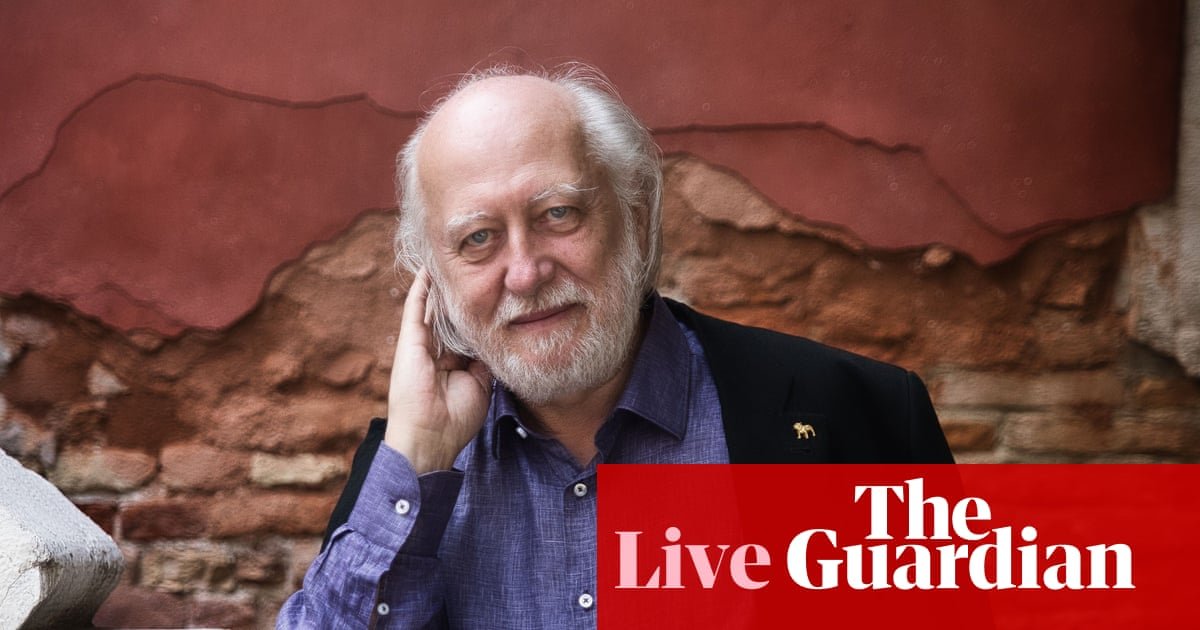
Nobel prize in literature 2025 live: László Krasznahorkai wins ‘for his compelling and visionary oeuvre’ | Nobel prize in literature

Check out our latest products
![[Upgraded] USB Computer /Laptop Speaker with Stereo Sound & Enhanced Bass, Portable Mini Sound Bar for Windows PCs, Desktop Computer and Laptops](https://m.media-amazon.com/images/I/61NAayKmVIL._AC_SL1500_.jpg)


László Krasznahorkai wins
Ella Creamer
László Krasznahorkai has won the 2025 Nobel prize in literature.
Key events
Announcing the winner in Stockholm, Mats Malm, permanent secretary and speaker of the Swedish Academy, said that he had “just reached László Krasznahorkai on the telephone, on a visit in Frankfurt, where he was.”
Who is winner László Krasznahorkai?
Emma Loffhagen
Born in Gyula, Hungary, in 1954, Krasznahorkai first made his mark with his 1985 debut novel Sátántangó, a bleak and mesmerising portrayal of a collapsing rural community. The novel would go on to win the Best Translated Book award in English nearly three decades later, in 2013.
Often described as postmodern, Krasznahorkai is known for his long, winding sentences, dystopian and melancholic themes, and the kind of relentless intensity that has led critics to compare him to Gogol, Melville and Kafka. Sátántangó was famously adapted into a seven-hour film by director Béla Tarr, with whom Krasznahorkai has had a long creative partnership.
Krasznahorkai’s career has been shaped by travel as much as by language. He first left Communist Hungary in 1987, spending a year in West Berlin for a fellowship, and later drew inspiration from East Asia – particularly Mongolia and China – for works such as The Prisoner of Urga, and Destruction and Sorrow Beneath the Heavens.
While working on War and War, he travelled widely across Europe and lived for a time in Allen Ginsberg’s New York apartment, describing the legendary Beat poet’s support as crucial to completing the novel.
His admirers are formidable: Susan Sontag called him “the contemporary Hungarian master of apocalypse,” while WG Sebald praised the universality of his vision. In 2015, Krasznahorkai became the first Hungarian writer to win the Man Booker International prize.

Ella Creamer
Hungarian author László Krasznahorkai has been chosen as the winner “for his compelling and visionary oeuvre that, in the midst of apocalyptic terror, reaffirms the power of art.”
László Krasznahorkai wins
Ella Creamer
László Krasznahorkai has won the 2025 Nobel prize in literature.
Emma Loffhagen
If American writer Thomas Pynchon wins today, (the bookies have him 16/1) it will be like awarding the Nobel to a ghost – he’s fiercely and famously reclusive. The 88-year-old once refused to collect a 1974 National Book award for Gravity’s Rainbow, sending a comedian as a stand-in instead.
Few photographs of Pynchon have ever been published, and rumours about his identity and whereabouts have swirled for decades. In 2004, he made his only well-publicised media cameo: on The Simpsons. His animated self appeared wearing a paper bag over his head (a nod to his elusiveness) – and he even edited his own script, demanding Homer not be called a “fat-ass.”
When CNN filmed him in 1997, he asked them not to air the footage, quipping: “My belief is that ‘recluse’ is a code-word generated by journalists, meaning: ‘doesn’t like to talk to reporters’”.
So if the Nobel does go to Pynchon, don’t expect a televised acceptance speech.
Possible winner: Haruki Murakami
Emma Loffhagen
Few names are as closely associated with the Nobel prize in literature without ever (yet) winning it as Haruki Murakami. The Japanese novelist, essayist and translator has been a bookies’ favourite for years, thanks to a vast global readership and a unique literary voice.
Born in Kyoto in 1949, Murakami came to writing relatively late. He ran a jazz bar in Tokyo before publishing his debut novel Hear the Wind Sing in 1979. It won the Gunzou Literature prize and launched a career that would make him one of the most widely read authors in the world.
Murakami’s work blends the everyday and the surreal, often following lonely, introspective characters as they drift between ordinary reality and strange, dreamlike worlds.
His best-known novels include Norwegian Wood (1987), a breakout hit that made him a literary star in Japan; The Wind-Up Bird Chronicle (1994); Kafka on the Shore (2002); and 1Q84 (2009). His fiction features jazz, cats, wells, disappearances and quiet obsessions, elements that have become instantly recognisable Murakami signatures.
A prolific translator of American writers such as Raymond Carver and F Scott Fitzgerald, Murakami has long bridged cultures.
While immensely popular with readers, Murakami’s relationship with Japan’s literary establishment has sometimes been complicated – he has been criticised for being “un-Japanese”, leading to the author claiming that he was a “black sheep in the Japanese literary world”. The Nobel prize has eluded him despite perennial predictions. He has, however, received numerous honours, including the Franz Kafka prize (2006), the Jerusalem prize (2009) and the Hans Christian Andersen literature award (2016).
Who is the bookies’ favourite, Can Xue?
Ella Creamer
The experimental Chinese author has been the bookies’ favourite for several years running now.
She has had some international recognition already, having been longlisted for the International Booker prize in 2019 and 2021, first for her novel Love in the New Millennium, translated by Annelise Finegan Wasmoen, and then for her short story collection I Live in the Slums, translated by Karen Gernant and Chen Zeping.
Can Xue, whose real name is Deng Xiaohua, was born in 1953 in Changsha, Hunan province. In the late 50s, her parents were condemned as ultra-rightists. Her father was sentenced to re-education through labour and in 1967, during the Cultural Revolution, he was jailed. Can Xue couldn’t continue her education beyond elementary school, and is largely an autodidact.
If she is named Nobel laureate in literature, she will be the 19th woman to win the prize and the third Chinese-born winner.
Ella Creamer
“I think after varying last year (when Han Kang won) from their usual taste for European modernism, the committee might revert to form this year”, says critic John Self. “That could mean László Krasznahorkai (long sentences – very Nobel), Mathias Énard (published by Fitzcarraldo, another good sign) or Enrique Vila-Matas (though his stuff is probably a bit too much fun to win). Of course maybe one of the regularly tipped favourites will win this year, like Australia’s Gerald Murnane, who has the right level of eccentricity and unique vision. When I interviewed him last year and asked what he thought about all the Nobel speculation, he joked, ‘I’d like the money’.”
Ella Creamer
Albert Camus explored existentialism, the absurd, and the moral choices we face in an uncertain world. He was awarded the 1957 literature prize.
Who will be the next voice to shape literature? Find out later today when we announce the 2025 laureate(s). pic.twitter.com/nd8G8fbs9u
— The Nobel Prize (@NobelPrize) October 9, 2025
Emma Loffhagen
While many Nobel literature laureates are celebrated novelists and poets, the Swedish Academy has a long history of awarding the prize to unexpected figures.
Perhaps the most famous recent example is Bob Dylan, who won in 2016. When the Academy announced it was honouring him “for having created new poetic expressions within the great American song tradition,” the response was immediate and polarising. Fans hailed the decision as groundbreaking, recognising songwriting as a legitimate literary art. Critics, however, questioned whether a musician should receive an award traditionally reserved for novelists, poets and playwrights. Dylan’s initial silence, and his decision not to attend the ceremony, only intensified the debate.
A few years later, in 2019, the prize went to Peter Handke, the Austrian novelist and playwright. The decision drew fierce criticism because of Handke’s public support for Slobodan Milošević and comments downplaying Serbian war crimes during the Yugoslav wars. Several writers, politicians and cultural figures condemned the Academy’s choice; some boycotted the ceremony.
Going back further, Dario Fo, the Italian playwright and satirist, stunned many when he was named laureate in 1997. Known for his politically charged, often anarchic theatre, Fo was adored in some circles and dismissed in others. The Academy’s decision to celebrate him over more traditional literary figures raised eyebrows, though it also underlined their willingness to challenge expectations.
Another surprising choice came in 1953, when Winston Churchill received the prize for his historical writings and oratory. Many questioned whether a statesman should be honoured over major literary figures of the era.
Other contentious choices have included Harold Pinter in 2005, whose biting political speeches overshadowed his award. Earlier, in 1964, Jean-Paul Sartre made history by declining the Nobel prize altogether, saying a writer should not allow themselves to be turned into an institution – another moment that fuelled debate about the role and meaning of the award.